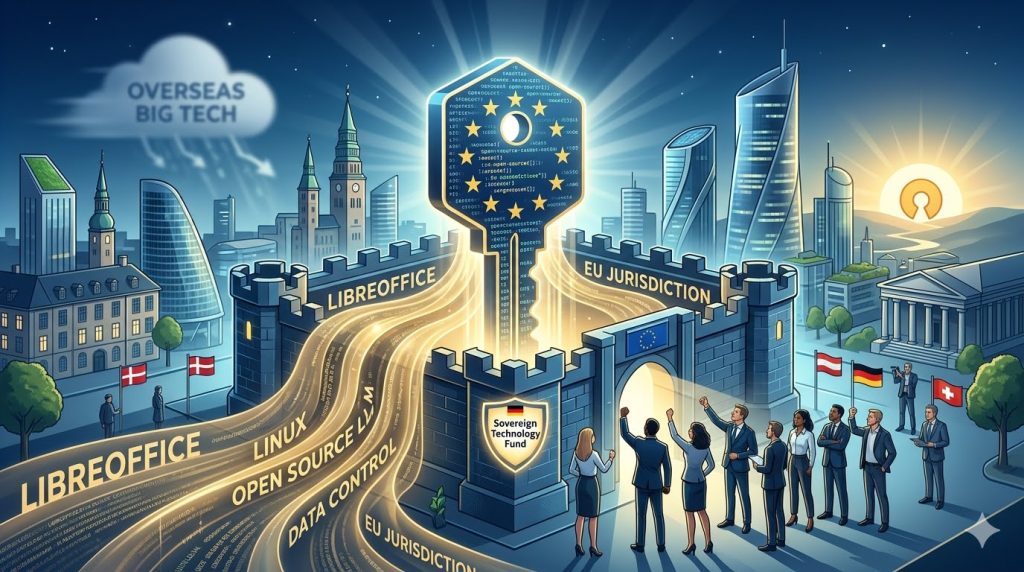
We are at an unprecedented technological crossroads. What was once a niche debate for academics has exploded between 2025 and 2026 into a brutal political and strategic urgency: Digital Sovereignty. From Denmark’s radical shift toward Linux and LibreOffice to the massive investments of the Sovereign Technology Fund, Europe is finally rising to reclaim the keys to its critical infrastructure.
In this post, we explore how open source is becoming the bedrock of our independence, the crucial role of “transparent” AI, and the risk of falling behind in the global race for digital skills. True autonomy isn’t just about the software we use; it’s about the responsibility we take to own our digital future.
Index
- The awakening of digital autonomy
- Denmark sets course: Linux and LibreOffice become state-owned
- Follow the Money: How the German Sovereign Wealth Fund Is Financing European Autonomy
- Chain Reaction: SUSE and Red Hat’s “Sovereign” Support
- Artificial Intelligence has a Swiss (and open-source) heart
- Not just states: sovereignty is an individual right (and Italy is struggling)
- Conclusion: A technological crossroads between freedom and awareness
The awakening of digital autonomy
For too long, we’ve lived in a state of technological torpor, accepting near-total dependence on large overseas multinationals as a necessary evil. However, between 2025 and 2026, we’ve witnessed a veritable earthquake: Digital Sovereignty has gone from an abstract concept for academics to a brutal political and strategic urgency. It’s no longer just a matter of “saving on licenses,” but of deciding who holds the keys to our critical infrastructure. In this post, we’ll explore how Europe is finally raising its head, embracing open source not as a fallback, but as a fundamental pillar of a new technological independence.
Denmark sets course: Linux and LibreOffice become state-owned
The most resounding sign of disruption comes from Northern Europe. The Danish government has broken the deadlock by announcing the systematic abandonment of Microsoft Office and proprietary suites in favor of LibreOffice and Linux.
This is not a typical niche technical experiment, but a momentous paradigm shift. While in the past, the debate over desktop Linux was bogged down in secondary issues like gaming or free software, today digital sovereignty has become the true driving force behind the adoption of open source. Denmark has understood that remaining tied to the lifecycles and unilateral decisions of a single foreign vendor is an unacceptable geopolitical risk. It is choosing open source to reclaim the right to decide its own digital future, breaking the chains of vendor lock-in.
Follow the Money: How the German Sovereign Wealth Fund Is Financing European Autonomy
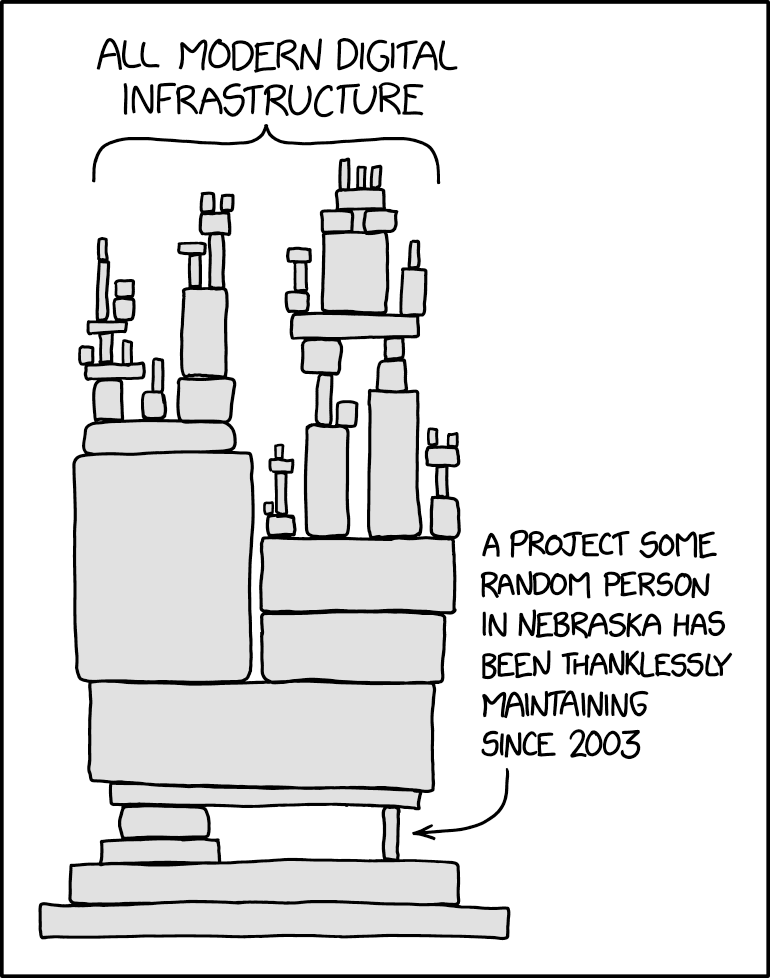
The revolution needs fuel, and that fuel has a name: the Sovereign Technology Fund. Inspired by the German model—which has been investing heavily in the open-source ecosystem since 2022—this approach is becoming the benchmark for the entire European Union.
We’re not talking about simple, blanket subsidies, but strategic investments to make digital sovereignty a financially sustainable project. Actively supporting the development of open technologies means ensuring that the critical software underpinning our public services is transparent, verifiable, and protected from purely extractive market logic. It demonstrates that independence isn’t just a romantic ideal, but a serious, long-term business plan. (Daniel Stenberg’s post is enlightening!)
Chain Reaction: SUSE and Red Hat’s “Sovereign” Support
The market doesn’t move purely on ethics, but follows the direction of capital and policies. The push from the Sovereign Wealth Fund and new regulations has forced industry giants to rethink their business models. SUSE, with the launch of its “Sovereign Premium Support” in July 2025, and subsequently Red Hat in November of the same year, began offering solutions specifically designed for the sovereignty needs of the European market.
This “sovereign-centric” support responds to a specific demand: companies and public administrations require ironclad guarantees regarding compliance and local data control. Today’s market no longer demands merely “software that works,” but demands the certainty that control of code and information remains under European jurisdiction, protected from sudden legislative changes in third countries.
Artificial Intelligence has a Swiss (and open-source) heart

The battle for sovereignty has now shifted to the most critical frontier: Artificial Intelligence. In July 2025, the project for the first open-source European LLM (Large Language Model) was presented, trained using the power of a Swiss supercomputer.
Why is this project crucial? Because it addresses the problem of data opacity. In proprietary LLM programs, no one really knows what ends up in the training “cauldron.” Digital sovereignty applied to AI requires algorithm transparency and rigorous control of datasets. In a world where AI will make vital decisions, knowing “how” an algorithm thinks is a national security requirement, not just a technical detail.
Not just states: sovereignty is an individual right (and Italy is struggling)
Codemotion 2025 highlighted an often overlooked aspect: digital sovereignty, as highlighted by the Digital Sovereignty Index, is not just a game between states and Big Tech, but a skill that concerns individual professionals and citizens. There is increasing talk of “Personal Sovereignty,” or the ability to manage one’s data and identity without necessarily having to go through intermediaries who act as gatekeepers to our digital lives.
Unfortunately, the national picture presents us with a grim reality.
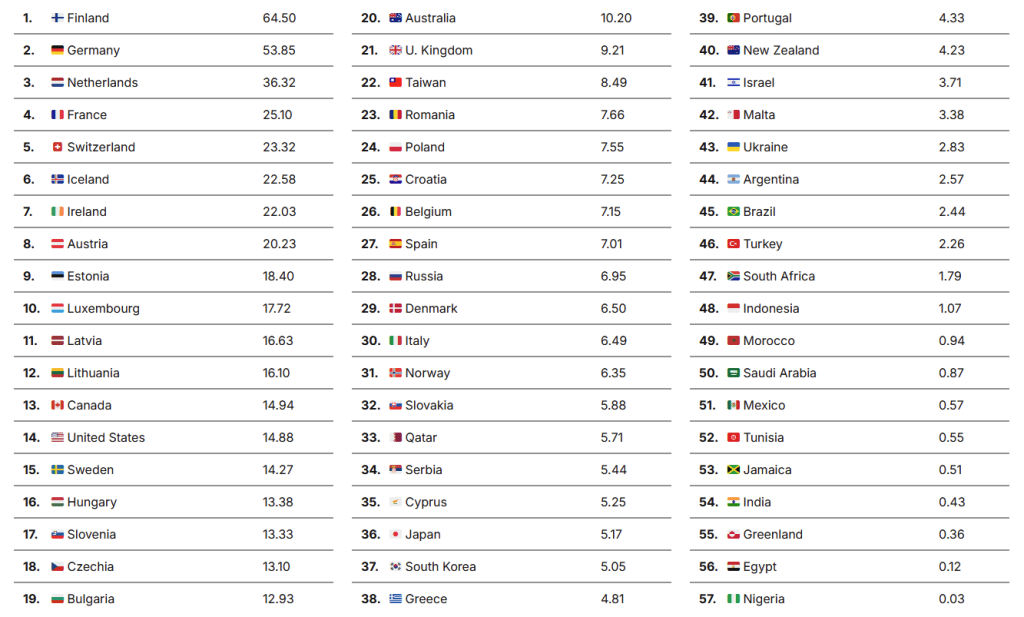
This data should be a wake-up call. Without massive growth in independent digital skills, we risk remaining passive spectators of a revolution that others are leading. Sovereignty cannot be bought; it is exercised through knowledge.
Conclusion: A technological crossroads between freedom and awareness
The path to autonomy is finding an institutional framework thanks to the work of OSOR (Open Source Observatory), which in January 2026 gave visibility to the European Commission’s “Call for Evidence” to define a common open-source strategy. But beware: changing software isn’t enough without changing our mindset.
What if abandoning the Microsoft suite for digital sovereignty means jumping from the frying pan into the fire?
The real risk is replacing a proprietary giant with an open-source solution managed by external service providers without the internal expertise to manage it. Without true awareness, we will simply end up changing the name of our technological “jailer.” Digital freedom requires responsibility and continuous investment in human talent.
Just one last (and useful) consideration: I would take a look here
 English